
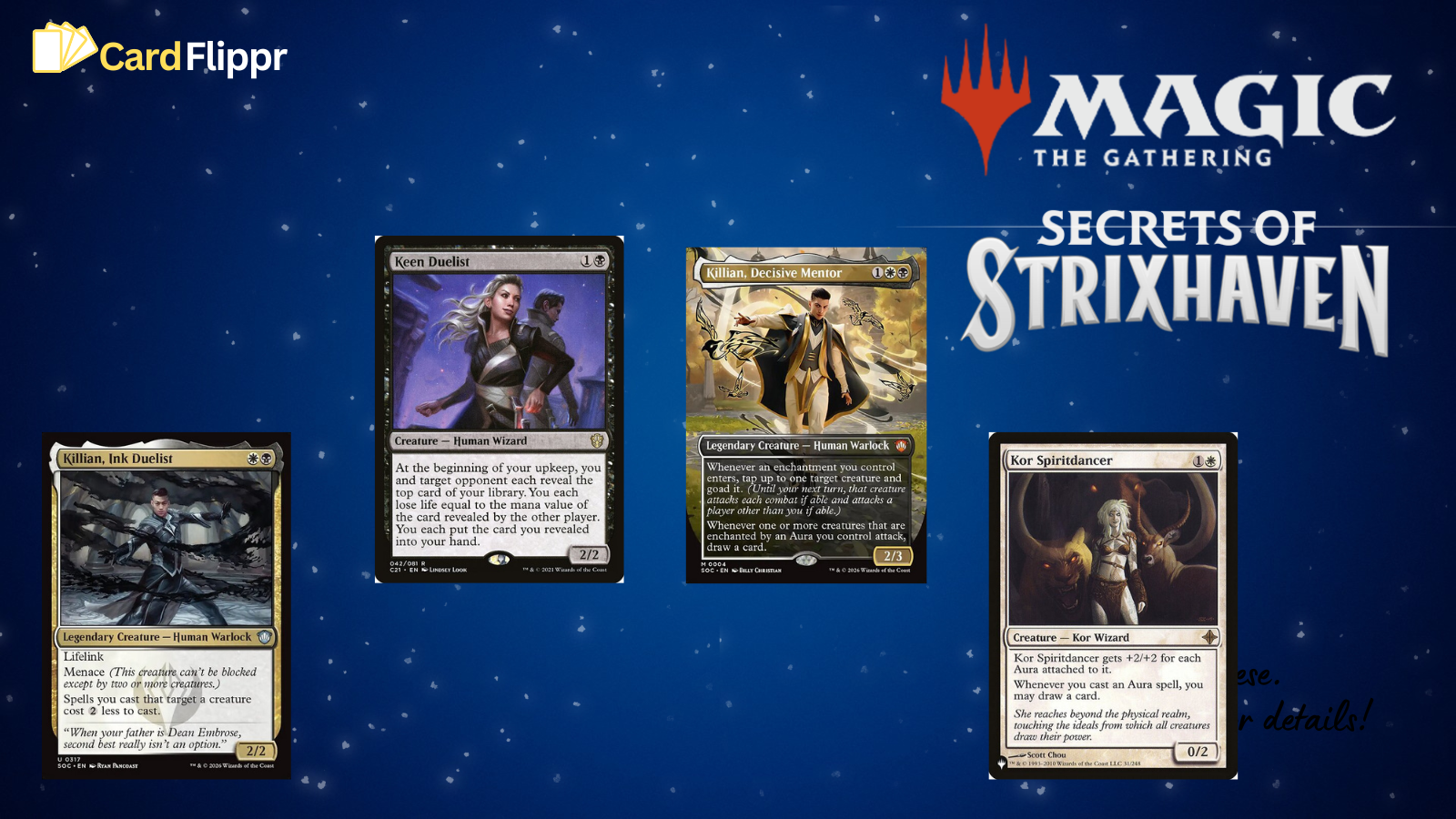
This isn’t a typical Commander deck. Silverquill Influence plays like a political control engine rather than a straightforward combat strategy. Instead of overpowering opponents, you manipulate how and where combat happens, turning other players into your tools.
If you try to play this like a standard Orzhov deck focused on removal and lifegain, it will feel underpowered. If you lean into control, influence, and timing, it becomes extremely effective.
Core Identity: Political Enchantress Control
The deck combines three main ideas: enchantment-based value, combat manipulation, and multiplayer politics. It uses auras and enchantments to generate incremental advantage while encouraging opponents to attack each other instead of you.
The commander, Killian, Decisive Mentor, reduces the cost of spells that target creatures, which makes aura-based gameplay more efficient. This allows you to deploy multiple enchantments quickly and gain value across the table.
The overall strategy is simple in concept but nuanced in execution: influence the board without becoming the threat.
How the Deck Plays
Early Game (Turns 1–4)
Your goal early is to set up resources and avoid drawing attention. You want to establish mana, play low-cost enchantments, and begin lightly influencing the board.
You should not be aggressive. Instead, position yourself as non-threatening while quietly building value. Enchanting opponent creatures early can already start generating advantages, but keep it subtle.
Mid Game (Turns 5–8)
This is where the deck starts to function as intended. You begin to actively manipulate combat by incentivizing attacks away from you and toward other players.
You can use enchantments and abilities to reward opponents for attacking elsewhere or make it disadvantageous for them to target you. At this stage, you are shaping the flow of the game rather than reacting to it.
The deck often behaves like a selective group hug strategy. You provide benefits, but only in ways that align with your long-term plan.
Late Game (Turn 9+)
By the late game, your incremental advantages start to compound. Opponents are weakened from fighting each other, and you are in a position to convert that advantage into a win.
You typically close the game through accumulated value rather than a single explosive combo. This might involve buffed creatures, sustained board control, or leveraging enchantment-based scaling effects.
Key Strategic Pillars
Combat manipulation is your primary tool. Instead of removing threats, you redirect them. Effects that force or incentivize attacks elsewhere are central to your plan.
The enchantment engine provides your card advantage. Auras and enchantments generate ongoing value, especially when spread across multiple players’ creatures.
Politics is a core skill component. The deck rewards players who can read the table, anticipate reactions, and influence decisions indirectly.
Weaknesses and Limitations
The deck is relatively low in raw power out of the box. It depends on opponents’ actions and requires time to build momentum.
Card draw can feel inconsistent if you are not triggering multiple interactions per turn cycle. Without optimization, you may run out of resources.
It struggles against fast combo decks because it does not apply early pressure or strong disruption by default.
It also requires strong decision-making and awareness. Misjudging the table can quickly make you the primary target.
Upgrade and Optimization Strategy
Strengthening the enchantment core is the most direct improvement. Adding more draw engines, cost reduction, and recursion makes the deck significantly more consistent.
Introducing a stronger control layer helps against aggressive and combo-heavy tables. Additional removal, board wipes, and taxing effects increase survivability.
The deck benefits from more focused win conditions. Instead of relying on general value, you should decide on a clear path such as enchantment scaling, Voltron-style finishing, or incremental drain.
You can also improve performance by increasing the number of triggers per turn cycle. The deck scales with interaction frequency, so anything that multiplies triggers or spreads effects across multiple players increases effectiveness.
Overall Verdict
The deck sits at a moderate power level out of the box but has a very high skill ceiling. It is one of the more unique Commander experiences because success depends heavily on how you play rather than just what you play.
It is especially strong in casual multiplayer environments where combat and interaction matter. However, it needs upgrades to perform consistently against optimized or combo-heavy decks.
Final Take
Silverquill Influence is not about brute force. It is about control through influence. The more effectively you shape the decisions of others, the stronger the deck becomes.
If you prefer direct, aggressive strategies, this deck will feel slow. If you enjoy controlling the flow of the game and winning through positioning and timing, it offers a highly rewarding playstyle.