
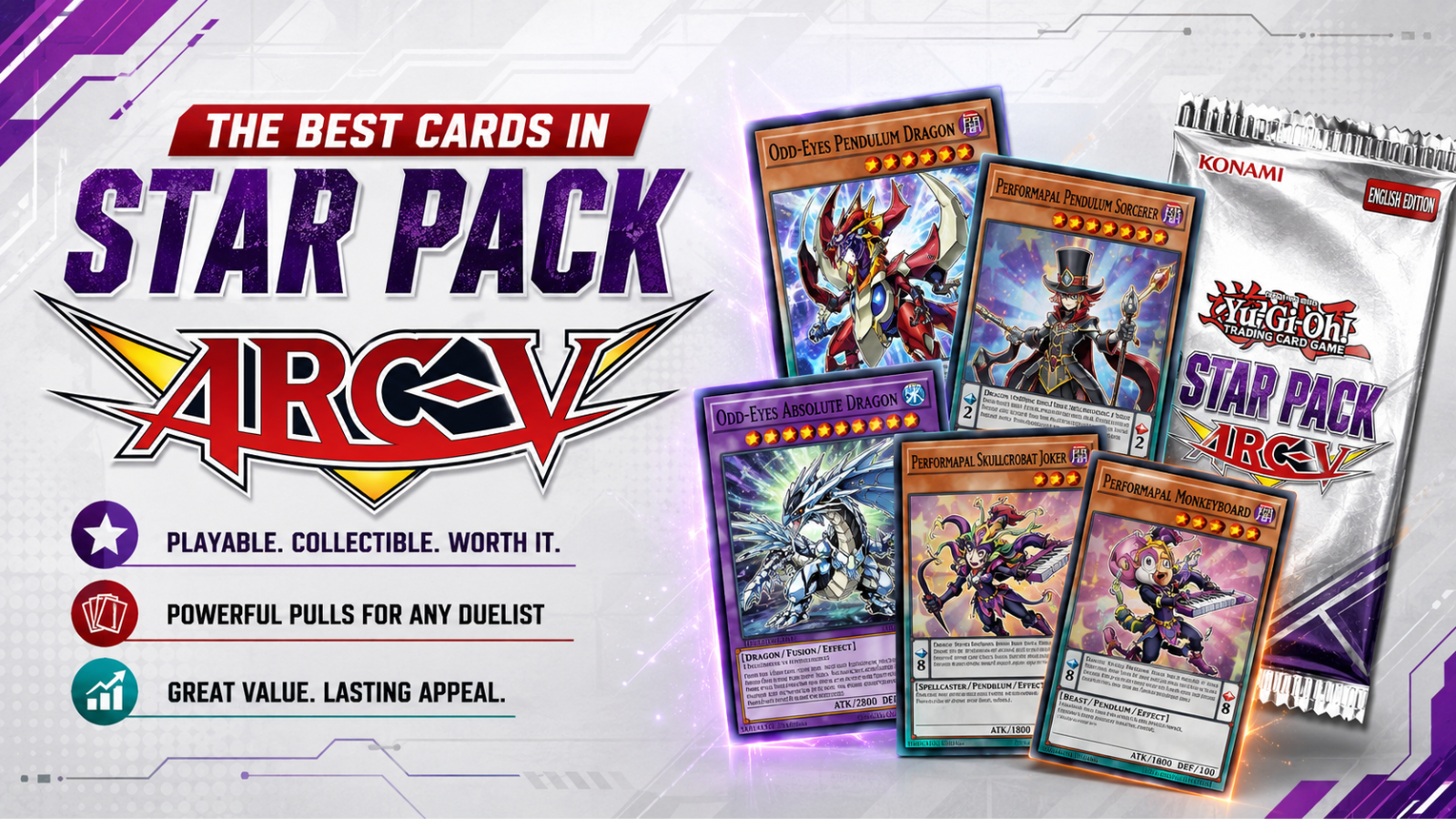
[Star Pack ARC-V] sits in an interesting place in Yu-Gi-Oh! history: it was designed as an accessible, low-cost product, but today its best cards are judged by a very different metric. Some pulls still matter for casual decks and nostalgic builds, while others have become binder staples because of their artwork, theme support, or long-term collector appeal.
If you are thinking about [Star Pack ARC-V] from an economics angle, the key question is not just which cards are strongest in a duel. It is which cards remain useful, which cards are easiest to trade, and which cards can hold attention because they connect to popular themes that players still recognize.
Why [Star Pack ARC-V] Still Matters in the Market
[Star Pack ARC-V] was built around opening excitement at a low price point, which means most copies are easy to find and still relatively affordable. That makes the set especially appealing to new collectors, budget duelists, and players looking for casual upgrades without committing to premium singles. The set’s long-term value is driven less by scarcity than by demand concentration: a small group of cards accounts for most of the interest.
From a market perspective, this creates a simple rule. The cards worth paying attention to are the ones with one or more of these traits: recurring casual play, name recognition from anime-era themes, compatibility with multiple deck shells, or visually appealing artwork that makes them trade-friendly. That is why the best cards in [Star Pack ARC-V] are not always the flashiest, but they are often the most dependable.
Cards in [Star Pack ARC-V] With the Best Gameplay Value
For gameplay, the most relevant cards are the ones that either slot into existing strategies or serve as efficient utility pieces. In a set like [Star Pack ARC-V], “playable” usually means beginner-friendly rather than format-defining, but that does not make the cards unimportant. Budget duelists often build around these cards because they reduce deck cost while still teaching core gameplay patterns.
[Odd-Eyes Pendulum Dragon] and the Pendulum Payoff
[Odd-Eyes Pendulum Dragon] remains one of the most recognizable cards from the [ARC-V] era, and that recognition matters. It is a signature card for Pendulum-focused builds, and its usefulness extends beyond pure nostalgia because it supports the core idea of scale-based summoning and flexible board development. Even when it is not the most efficient option in a competitive list, it remains a staple for casual Pendulum players and collectors who want a central anime-era card with real deck identity.
From an economic lens, the value here is stability. Signature monsters linked to iconic mechanics tend to maintain steady demand because they are the first cards players buy when building around that mechanic. If someone wants to enter Pendulum play, [Odd-Eyes Pendulum Dragon] often becomes part of the shopping list immediately.
[Performapal Pendulum Sorcerer] as a Utility Pull
[Performapal Pendulum Sorcerer] is a strong example of a card whose value comes from versatility. It fits into [Performapal] and broader Pendulum strategies, and its ability to support plays through monster and scale interaction gives it real utility in casual and semi-competitive environments. Even if a player is not chasing top-tier optimization, this kind of card helps streamline turns and makes Pendulum decks feel more consistent.
Cards like this tend to age well because they are not dependent on a single narrow combo line. They are easier to trade, easier to explain to new players, and easier to keep in a binder as a “good card to have” rather than a speculative hold.
[Odd-Eyes Absolute Dragon] for Deck Builders
[Odd-Eyes Absolute Dragon] is another card that retains practical appeal because it connects directly to [Odd-Eyes] strategies and offers a recognizable Extra Deck payoff. For players experimenting with Dragon-focused or Pendulum-focused builds, it serves as a bridge card that rewards board setup and helps establish pressure. In terms of value, Extra Deck monsters with clear home-deck identity often stay relevant longer than generic bulk because players actively seek them when revisiting a theme.
That theme loyalty matters. When a player starts building a project deck, they usually want the cards that feel “correct” for the archetype, and [Odd-Eyes Absolute Dragon] has that kind of built-in demand.
Binder Appeal: What Collectors Actually Want
Not every good [Star Pack ARC-V] card needs to win games to be worth keeping. In fact, some of the strongest long-term opportunities come from cards that are visually memorable or tied to fan-favorite themes. Collector appeal often outlasts short-term gameplay trends because nostalgia is less volatile than a metagame.
The best binder cards in this product usually fall into one of three categories: iconic anime monsters, attractive support cards from recognizable themes, and low-cost pulls that still feel meaningful in a themed collection. When a card can satisfy both the casual collector and the returning player, it becomes much easier to move in trades and much easier to justify holding.
[Performapal Skullcrobat Joker] and Theme Recognition
[Performapal Skullcrobat Joker] is one of the most notable names associated with [ARC-V]-era Pendulum decks. Even beyond actual play, the card has strong theme recognition because it sits at the center of the [Performapal] identity for many players. That makes it a strong binder card: people remember it, look for it, and often want a copy when assembling a character-themed or anime-inspired collection.
For collectors, this is important because recognizable support cards often see more consistent casual demand than forgotten chase cards. A card like this may not be expensive, but it is easy to trade because it solves a very common problem: “I need the signature support card for my theme deck.”
[Performapal Monkeyboard] and Demand Memory
[Performapal Monkeyboard] has a reputation that helps it in the secondary market. Cards that were once highly discussed tend to maintain a kind of demand memory, even after their competitive peak passes. That makes [Performapal Monkeyboard] interesting from an economics standpoint, because players often associate it with the broader power level of early [Performapal] builds.
For a collector, that history adds context. A card does not need to be format-breaking forever to remain desirable. If it played a notable role in a recognizable deck ecosystem, it can keep interest simply because it represents a moment in the game’s evolution.
What Holds Value Best: Playability, Nostalgia, or Scarcity?
When evaluating [Star Pack ARC-V], it helps to separate value into three buckets. First is gameplay value, meaning a card has an immediate role in a deck. Second is nostalgia value, where a card matters because of the anime, theme, or era it represents. Third is scarcity value, which depends on how difficult it is to find clean copies in the condition buyers want.
In this set, nostalgia is often the strongest long-term driver. [Odd-Eyes Pendulum Dragon] and [Performapal Skullcrobat Joker] benefit from being central to a widely recognized era. Gameplay value supports the floor because these cards still get used in casual and retro decks. Scarcity is weaker than in premium products, but near-mint copies can still stand out when buyers want clean binder presentation.
The practical takeaway is that the safest cards to hold are the ones with cross-category demand. A card that is both playable and iconic has more ways to attract buyers than a card that is only one or the other.
Buying and Trading Strategy for [Star Pack ARC-V]
If you are approaching [Star Pack ARC-V] as a player-investor or trade binder strategist, focus on liquidity rather than hype. Cards that can move quickly in local trades usually provide better real-world value than cards that look exciting but have no audience. A good rule is to prioritize cards tied to [Odd-Eyes], [Performapal], and other recognizable [ARC-V] themes, especially if the card is clearly useful to someone building a themed deck.
- Buy for play: Choose cards that help a beginner learn a mechanic, such as scale management or Extra Deck sequencing.
- Trade for recognition: Keep copies of iconic names that older or returning players will instantly recognize.
- Hold for binder appeal: Favor cards with strong artwork, anime relevance, or clean condition.
- Avoid overpaying: Most [Star Pack ARC-V] cards are not premium scarcity pieces, so condition and demand matter more than speculation.
For advanced players, the best opportunity is often to buy these cards in lots or use them as throw-in value during trades. Because the set is accessible, many copies circulate at low cost. That keeps entry barriers low but also means the market rewards patience and smart timing more than impulsive buying.
Final Verdict: The Best [Star Pack ARC-V] Cards Are the Ones With Staying Power
[Star Pack ARC-V] is not a product where every card is a standout investment, but that is exactly why the best cards are easy to identify. Look for the names that players still remember, the cards that still support a deck plan, and the pulls that collectors are happy to display. [Odd-Eyes Pendulum Dragon], [Performapal Pendulum Sorcerer], [Odd-Eyes Absolute Dragon], [Performapal Skullcrobat Joker], and [Performapal Monkeyboard] all fit that profile in different ways.
If you are building a binder, upgrading a casual deck, or sorting bulk for trade value, this set rewards targeted attention. The cards with the most staying power are the ones that connect gameplay, nostalgia, and theme identity. That combination is what keeps [Star Pack ARC-V] relevant today, and it is why the right pulls can still be worth playing, collecting, and trading long after the set’s initial release.
Bottom line: treat [Star Pack ARC-V] like a low-cost pool of recognizable deck pieces, not a lottery ticket. The best buys are the cards that a player would actually want now, not just the cards that looked exciting when the pack was first opened.