
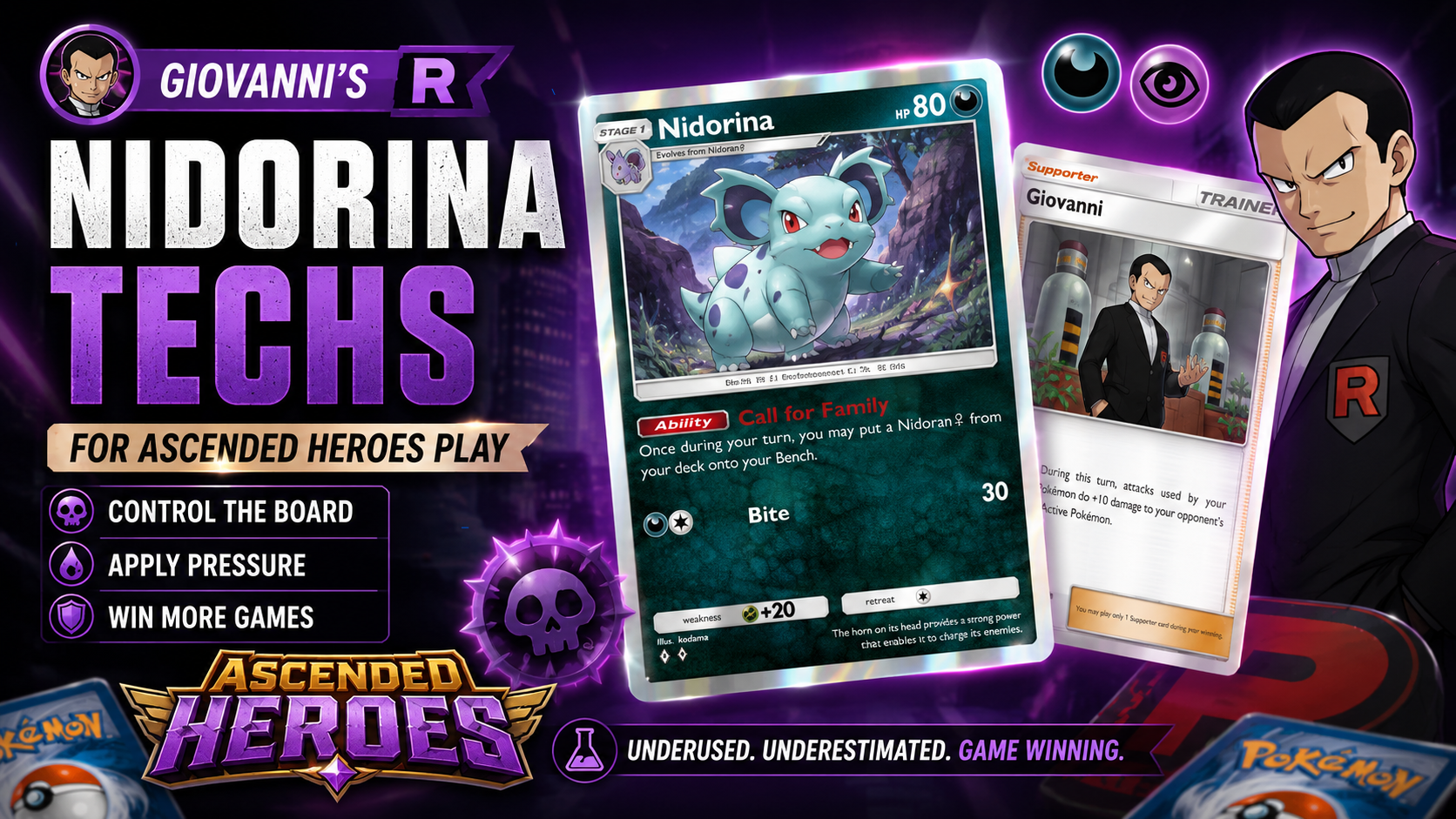
In tournament prep, the best tech cards are rarely the flashiest ones. [Giovanni's Nidorina] is a great example: it is a niche evolution-line piece that can matter a lot when your deck wants poison pressure, awkward prize trades, or a midgame attacker that forces inefficient responses. In the [Ascended Heroes] format, that kind of flexibility can be the difference between a clean 2-1 match record and an early exit.
This guide looks at when a Stage 1 line is worth the deck space, how to test it before a tournament, and which matchup profiles reward a copy of [Giovanni's Nidorina]. If you want a broader combat-focused breakdown first, you can also read Giovanni’s Nidorina Matchups: Winning Play Patterns after this article.
Why a Stage 1 tech can still be worth it
Most players are trained to ask the right question: does this card improve my expected matchups enough to justify the space? For [Giovanni's Nidorina], the answer depends less on raw damage output and more on what the card enables. A Stage 1 line can be worth testing when it does one or more of the following:
- Creates a poison or damage-counter pressure plan that forces awkward healing or switching decisions.
- Improves your midgame board presence so you can trade into smaller support Pokémon without spending your main attacker.
- Disrupts prize mapping by offering an alternate attacker your opponent cannot ignore.
- Buys time in games where your primary strategy needs an extra turn to set up.
The important part is that [Giovanni's Nidorina] should not be added because it feels “cute” or flexible in the abstract. It should be included because your expected field contains decks that dislike being pressured by incremental poison-style damage, or because your list can access a Stage 1 package without compromising consistency.
When evaluating a Stage 1 tech, compare it to the opportunity cost of the slots it takes. A one-of evolution line can be correct if it meaningfully changes one or two key matchups, especially in a best-of-three tournament where a single loss can end your run. For format context, official card text and deck legality can be checked through the Pokémon TCG card database and current tournament resources at Pokémon TCG rules and regulations.
What [Giovanni's Nidorina] does best in tournament prep
In practice, [Giovanni's Nidorina] is strongest when your deck wants a midgame pivot rather than a dedicated main attacker role. That means you are usually not trying to win the game solely with the Stage 1; you are trying to create a turn where your opponent must respond inefficiently while your primary attacker stays protected.
1. Poison pressure and soft prize acceleration
Poison-based pressure is at its best when it converts “almost enough damage” into real KO math. If your main attacker is just short of cleanly taking a knockout, a poison-style add-on can force the opponent to burn resources early. That matters against decks that depend on precise sequencing, because poison can break their carefully planned board state.
In [Ascended Heroes], that pressure is especially useful when opposing lists are built around evolving into a stable board and then snowballing with efficient attacks. A well-timed [Giovanni's Nidorina] can force the opponent to retreat, heal, or bench extra targets, all of which slows their game plan.
2. Disruption through tempo
Sometimes the value of a tech card is not the damage itself, but the turn it steals. If [Giovanni's Nidorina] can come down and create an immediate threat, your opponent may be forced to spend an attack dealing with it instead of advancing their own board. That is a classic tempo win: you spend a modest amount of deck space, and they spend a full turn answering it.
This is one reason players often test a Stage 1 tech in the same shell as a reliable draw engine, because the goal is to find the line when it matters, not every game. A clean setup supported by consistent draw is often the difference between a one-of package being brilliant and being dead in hand. For general deck construction and draw sequencing, many players start by comparing how well their list reaches key pieces with turn-one draw effects similar in role to [Professor Juniper], then adjust the line size from there.
3. Flexible midgame trades
Not every matchup is about sweeping big knockouts. Some games are won by making slightly better trades over three to five turns. That is where [Giovanni's Nidorina] can become useful: if it trades into support Pokémon, weak setup pieces, or damaged midrange attackers, it can convert a narrow board lead into a prize lead.
The key is to identify whether your list can actually leverage those trades. If your main attackers are already efficient and your deck is consistent, [Giovanni's Nidorina] may be a luxury. If your list sometimes stalls after the first attacker is removed, the Stage 1 can function as a stabilizer that keeps pressure on while you reload.
How to test the line before a tournament
Tournament prep should be structured, not emotional. The easiest way to overrate a tech card is to remember the games where it was excellent and forget the games where it was awkward. To get a realistic read on [Giovanni's Nidorina], run a focused testing block with clear goals.
- Play at least 10 games with the tech included. Do not judge from a single high-roll game.
- Track whether it was searched, drawn, or stranded. A powerful card that is hard to access may not be worth the slot.
- Note what it replaced. If the cut was consistency, ask whether the matchup gain really compensates.
- Test against the decks you expect to face most often. Techs should earn their place in real matchups, not only in theory.
- Check how often [Professor Juniper]-style draw lines help you find it. If your build cannot get to the evolution package on time, the card may be too slow for the format pace.
One practical trick is to keep a simple checklist after each game: did [Giovanni's Nidorina] change prize mapping, force a switch, soak an attack, or do nothing? If the answer is “nothing” too often, the line may be too narrow for your current field.
Another useful exercise is side-by-side testing. Play the same matchup with and without the tech, then compare the difference in turn count, prize trade quality, and whether your opponent had to deviate from their optimal plan. A tech that does not alter those outcomes is probably not pulling enough weight.
Matchups that reward this strategy
[Giovanni's Nidorina] is not designed to be universally strong. It rewards matchups where incremental pressure and board awkwardness matter more than raw speed. In [Ascended Heroes], that usually means games where opponents rely on clean evolution lines, careful retreat sequencing, or a limited number of key attackers.
Decks that dislike being forced off script
Opponents who need precise turns to evolve, draw, and attack are the best targets for disruption-based techs. If your opponent must protect a setup Pokémon or preserve a specific board state, poison-style pressure can force them into suboptimal play. That creates openings for your main attacker to clean up later.
Decks with narrow support boards
Some strategies win by keeping only a few Pokémon in play and avoiding unnecessary bench clutter. Against those decks, a flexible Stage 1 attacker can pick off support pieces or threaten damage where it matters. [Giovanni's Nidorina] becomes better when your opponent cannot easily afford to lose a small piece of their engine.
Prize race decks that are just a turn too slow
Any matchup where you are slightly behind in raw damage but ahead in planning is worth examining. If [Giovanni's Nidorina] turns a near-KO into a real knockout, or forces an extra retreat that opens a better trade next turn, it can swing a game that otherwise looks unfavorable on paper.
For more practical matchup thinking, revisit Giovanni’s Nidorina Matchups: Winning Play Patterns. That article is a useful companion piece because it helps you map how the card behaves once it hits the board, while this guide focuses on whether it deserves a slot in the first place.
Building around the tech without hurting consistency
The biggest trap with niche evolution lines is overbuilding them. If you add too many search pieces, recovery cards, or redundant copies, the deck starts to look like it is supporting the tech instead of the core strategy. The right approach is usually minimal but deliberate.
- Keep the line small unless the format proves otherwise. If one copy is enough to influence the field, do not inflate it.
- Prioritize draw consistency. A tech you can find when needed is better than one that sits in the deck all match.
- Protect your tempo. If evolving for [Giovanni's Nidorina] costs you a turn that your deck cannot spare, the line may be too clunky.
- Use testing data, not intuition. The best tournament lists are tuned from repeated reps, not from “feeling good” in goldfish games.
If your list already runs smooth draw and has enough space to support a single evolution package, [Giovanni's Nidorina] can be a sharp metagame call. If your deck is already tight, it may be better as a card to revisit when the field slows down or when the matchups you expect become more board-centric.
Final thoughts
[Giovanni's Nidorina] is the kind of card advanced players love to test because it asks the right tournament question: can a small evolution-line investment create meaningful pressure in the matches that matter most? In [Ascended Heroes], that question is worth exploring if your expected field rewards poison pressure, disruption, and flexible midgame trades.
Before locking it into your list, test it with intention, compare it against the cuts it requires, and judge it by how often it changes real prize maps. If it consistently creates awkward turns for the opponent and helps your deck close games that would otherwise slip away, it has earned its slot. If not, keep it in the binder and move on. Either way, disciplined testing will give you the answer much faster than guessing.
For players building tournament-ready lists, the best next step is simple: run your reps, review your matchup notes, and see whether [Giovanni's Nidorina] improves the games your deck most needs to win. That is the difference between a fun tech and a real competitive edge.